
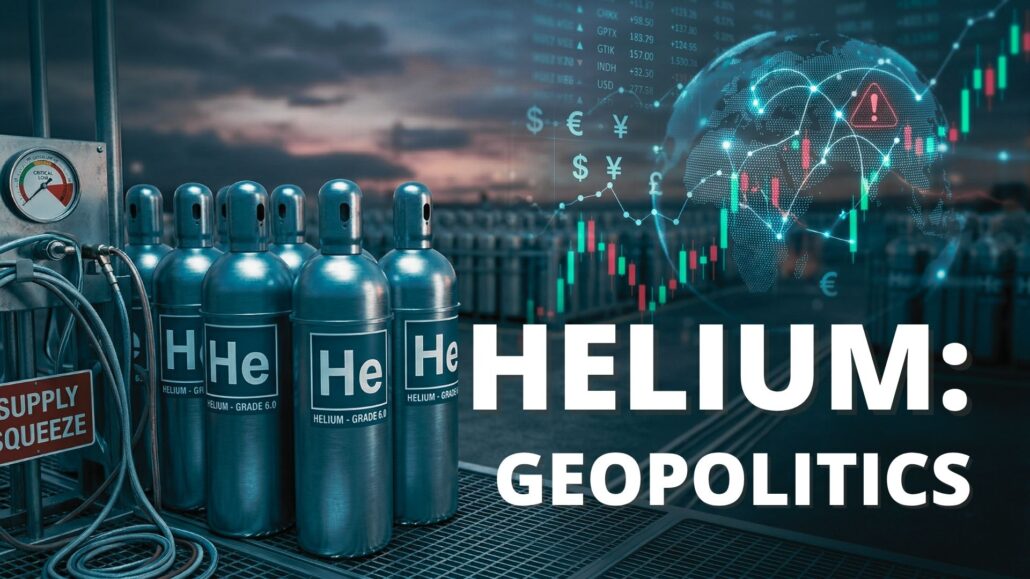
Investing in Helium
Long-Term Investor Lessons in a Constrained Commodity Market
Investing in helium is increasingly discussed among global investors — but headlines are not an investment strategy.
Instead of asking “Should I buy helium?”, long-term investors should ask: What structural forces drive the helium market — and how do they fit within a disciplined portfolio framework?
This guide follows a structured, educational format to help you evaluate helium using macro context, sector positioning, risk assessment, and practical implementation.
Lesson 1: Why Investing in Helium Starts with the Supply Shock
Why the backdrop matters before investing in helium
For years, the helium market was under slow structural pressure — under-investment in new production, tightening inventories, and rising demand from advanced industry. Then the war in Iran changed the timeline entirely.
The bombardment of Ras Laffan — Qatar’s primary industrial port and the source of roughly one third of global helium exports — took that supply offline almost overnight. Supply shocks fall into two categories:
- Cyclical: short-term outages that recover within months
- Structural: destroyed infrastructure or sanctions that take years to resolve
Qatari output is expected to stay around 15% below pre-war levels for at least five years, even if the conflict ends soon. This is structural, not cyclical.
To see how supply-side commodity shocks filter through to portfolios, see our guide on investing in commodity and energy stocks.
Lesson: Separate cyclical noise from structural change. Structural supply shocks reprice commodities for a decade.
Lesson 2: Demand Growth Meets Constrained Supply
Why timing makes this shock more severe
Helium demand was already forecast to grow roughly 50% over the next four years before the war — driven largely by semiconductor manufacturing and AI infrastructure buildout.
Key demand drivers:
- Semiconductor fabrication expansion in Asia and the US
- AI infrastructure requiring advanced chips
- Medical imaging growth in emerging markets
- Space launch activity and cryogenic cooling demand
The Ras Laffan shock landed on top of that demand trajectory — not instead of it. Rising demand meeting shrinking supply is the classic setup for multi-year repricing.
Lesson: Evaluate the demand trajectory alongside the supply disruption. One without the other is only half the story.
Lesson 3: Helium Does Not Behave Like Other Commodities
Three properties every investor should understand
It Cannot Be Substituted
Helium is irreplaceable in the processes that use it. There is no viable alternative for semiconductor fabrication cooling, MRI machine operation, or precision optics manufacturing. When it runs short, those industries slow down — there is no workaround.
It Cannot Be Recaptured
Once helium is used in an industrial process, it evaporates and rises out of the atmosphere entirely. It is light enough to escape Earth’s gravity field. Every unit consumed is permanently gone, and there is no recycling loop to fall back on.
It Cannot Be Shipped Easily
Unlike oil, helium requires cryogenic-temperature tanks for transport. That makes rerouting supply far slower and more expensive than redirecting a tanker. Qatar was the primary supplier to Asia — where most semiconductor production is concentrated — and that flow has now stalled.
Lesson: Commodity physics shape commodity markets. Non-substitutable, non-recyclable, hard-to-transport resources price differently than interchangeable ones.
Lesson 4: Supply Concentration Amplifies Risk
Why the global production map matters
Three countries dominate global helium supply:
- United States: largest producer
- Qatar: second, now severely disrupted
- Russia: third, constrained by ongoing sanctions and trade restrictions
Two of the top three producers are now facing significant disruption simultaneously. American production is rising, but not fast enough to fill the gap.
There is no single global helium price. Unlike oil (Brent, WTI) or gas (Henry Hub), helium is priced regionally through long-term contracts. The US price and the Middle East price have diverged sharply since the Ras Laffan attack, and there is no spot market a retail investor can track or trade.
Lesson: Map the supply base before evaluating commodity investments. Concentration creates both the opportunity and the risk.
Lesson 5: Downstream Effects Reach Further Than You Think
How a helium shortage filters through semiconductors, AI, and inflation
Semiconductor Manufacturing
Helium is embedded throughout chip fabrication — cooling systems, inert atmospheres during lithography, leak detection in equipment. Taiwan’s TSMC and the Netherlands’ ASML both depend on steady supply. A persistent shortage slows production timelines and pushes chip prices higher.
Artificial Intelligence Infrastructure
AI development depends on access to advanced semiconductors. If chip production slows and costs rise because of helium constraints, the cost structure of AI infrastructure shifts with it. It is not a sudden halt — it is a compounding drag that builds over quarters.
Stagflation Risk
ECB President Lagarde has flagged helium in recent public commentary. German inflation data this week showed price pressures accelerating. The broader concern is stagflation — rising prices driven by supply-side scarcity at the same time that economic growth weakens. Central banks then face an impossible position: cut rates to support growth, or raise them to fight inflation.
Helium is one thread in that picture, but a meaningful one. For investors thinking about how to position against that scenario, a properly structured portfolio with exposure to hard assets and short-duration fixed income becomes more relevant.
Lesson: Follow commodity shocks downstream. The second-order effects on equities, bonds, and inflation often matter more than the commodity price itself.
Lesson 6: The Investment Vehicles Are Limited
Why you cannot simply “buy helium”
There is no helium futures contract. No ETF that tracks it directly. The only equity exposure comes through small exploration and production companies based in Canada and the United States — which is exactly where the production advantage now sits.
These vehicles share predictable characteristics:
- Pre-revenue or early-revenue operations
- Significant price volatility on news flow
- Limited liquidity and wide bid-ask spreads
- Heavy dependence on a single resource thesis
Many investors therefore look at alternative commodity exposures and hard asset strategies as part of a broader inflation hedge rather than taking direct equity risk.
Lesson: The absence of mature investment vehicles is itself useful information. It tells you where retail demand has not yet arrived — and why volatility will be severe when it does.
Lesson 7: Four Companies Investors Are Watching
Speculative exposure, not core holdings
For educational purposes, these are the names most frequently discussed in the current helium supply story. None constitute a recommendation. All sit firmly in the speculative end of the risk spectrum.
First Helium (Canada)
The most operationally advanced of the group. Already generating some revenue and holding a meaningful cash buffer. Least speculative of the four — which still means genuinely speculative. Shares around CAD $4.
Pulsar Helium
In active exploration with early-stage pricing discussions underway. Further along than pure exploration plays. Shares around $1.75, with significant movement since the war began.
Helium One Global
Early-phase exploration. Higher upside potential if discoveries develop, higher risk if they don’t. Shares around £0.63.
Avanti Helium
The most speculative of the four — pre-production, primarily a resource estimate play. Around €0.25. Has seen sharp price movement since the Ras Laffan attack as the market prices in future scarcity rather than current output.
Lesson: In thinly traded commodity equities, company-specific risk often outweighs the commodity thesis. Do the work on each name individually.
Lesson 8: Risk Checklist Before Investing in Helium
Volatility is not a surprise — it is part of the package
Speculative commodity plays can deliver strong returns, but also elevated volatility. Before allocating capital, evaluate:
✔ Position size relative to total portfolio
✔ Balance sheet strength and dilution risk of the specific company
✔ Geopolitical scenarios — including Qatari supply returning
✔ Currency exposure versus your base currency
✔ Liquidity of the stock itself
✔ Political and regulatory stability across producing regions
Before taking any speculative position, it is worth understanding position sizing and when not to invest — especially in micro-cap commodities where volatility can be extreme.
Lesson: Position sizing is as important as thesis quality.
The Bigger Framework: Supply-Constrained Commodities
How structural scarcity shapes long-term allocation
Supply-constrained commodities tend to share a pattern. Long periods of under-investment followed by sudden repricing when a disruption meets rising demand:
- 1970s: Oil shocks and stagflation
- 2000s: Uranium supply crunch
- 2020s: Lithium, rare earths, and now helium
For most investors, the practical application is indirect. Helium scarcity feeds into semiconductor costs, inflation data, central bank policy, and the relative appeal of gold, silver, and short-duration sovereign debt.
UK gilts are currently yielding above 4%, versus around 2.7% for Dutch equivalents. Gold and silver have historically done well in stagflationary environments.
Helium is not replacing oil or lithium as a global commodity story. It may complement them.
Final Educational Takeaway
The disciplined way to think about investing in helium
Investing in helium is not about short-term excitement. It is about recognizing:
- A structural supply shock from Ras Laffan
- 50% demand growth over the next four years
- No substitute, no recycling, no easy transport
- Concentrated supply across three countries
- Downstream effects on semiconductors, AI, and inflation
The intelligent investor does not ask: “Which helium stock will triple next year?” Instead, they ask: “Does helium deserve a structural allocation within my long-term portfolio?”
That is the disciplined way to approach investing in helium.
Next step: build your investor foundation
If you want to invest in constrained commodity markets with more confidence, the most powerful upgrade is not a “hot pick” — it’s a repeatable process: diversification, position sizing, and risk management.
Explore our learning pathways: Browse Academy for Investors courses or start with a beginner track that fits your level.
Want the market discussion version of this topic? Watch Hugo Investing’s video:
Knowledge is not just power—it’s protection.
– Teachers of the Academy for Investors